
 Business License

Signal Hound PCR4200 4-Channel IQ Capture: Frame Drop After Minutes, Stop on Disk Full supplier
Signal Hound PCR4200 four-channel phase coherent receiver supplier
Recording IQ on All Four Signal Hound PCR4200 Channels Starts Dropping Frames After a Few Minutes and Stops When the Disk Fills — Capacity and Bandwidth Planning for Multi-Channel Capture
Symptom
Long-duration four-channel synchronous recording with the Signal Hound PCR4200 (drone video-transmitter analysis, array signal evidence preservation): recording 40 MHz on a single channel works fine; open all four channels and frames start dropping after a few minutes; recording stops automatically after 2–3 hours; playback reveals the per-channel files have unequal lengths and their time axes don't match. Switching to a high-capacity mechanical disk array changes nothing.
Root-Cause Analysis
This is the receiving end's "last mile of the data plane," and four channels are four times as demanding as one (engineering estimates; actual figures depend on the real word width and format):
The throughput bill: 4 channels × 40 MHz × 16-bit I/Q ≈ 640 MB/s sustained write — more than any single SATA SSD can take (sustained writes of 300–500 MB/s, and fluctuating on large files). A mechanical array without striping fails just the same;
The capacity bill: 640 MB/s ≈ 2.3 TB per hour. "Record overnight" means 20 TB or more; when the disk fills, recording stops. Most broken-recording incidents happen because nobody did this arithmetic;
Four streams trampling each other on one volume: writing all four channels to the same disk / same storage pool amplifies seek-head and garbage-collection jitter fourfold, so buffers overflow and frames drop;
Time base for segmented capture: when rotating across multiple files, each channel segments independently. Without a unified timestamp / sequence number for alignment, playback finds "the files don't match";
Recording directly onto network storage: NFS/SMB metadata hiccups (snapshots, antivirus scans) are fatal on a 640 MB/s stream, and a UDP stream waits for no one.
Solution
Group the storage architecture by channel: dedicate one enterprise NVMe per 1–2 channels (leaving ≥2× headroom on sustained write); or use RAID0 / a striped pool and measure sustained write and queue depth with iostat -x;
Do the math before you record: prior to recording, check available capacity against "bandwidth × duration × channel count," reserve a 30% free-space watermark at system level, and alarm and switch over automatically;
A unified segmentation protocol: segment all four channels on the same time axis (for example one group of four files every 60 s), name files with segment index plus segment-start timestamp, and have the playback tool verify sequence-number continuity per segment;
Tiered recording: for routine monitoring use a low-bandwidth mode (decimated sampling / fewer channels / DAS spectrum evidence), and only step up to full-speed IQ recording on an event trigger. The vast majority of array applications do not need 7×24 full-rate capture;
Use NAS for archiving only: record directly to local NVMe and bulk-transfer afterwards. Direct recording to a network volume requires a dedicated storage network plus measured sustained bandwidth ≥2× the total stream rate;
Rule out the link first: when frames drop, run a "receive without writing" stress test first. If it drops even without writing, investigate network / host (see the VITA-49 article); only if it is clean without writing should you look at storage.
Acceptance Criteria
Four channels at full rate recording continuously for ≥2 hours: no holes in sequence numbers, per-channel file time axes strictly aligned, no interrupted recording. Simulate a full-disk scenario and confirm the system alarms and stops recording safely, with every sealed segment 100% playable. The capacity planning table is part of the project delivery documentation.
Sources: compiled from Signal Hound PCR4200 product specifications (4 channels × 40 MHz VITA-49 streaming I/Q, 10GbE); throughput and capacity figures are engineering estimates derived from the sampling parameters.
Recently Posted
-
The Signal Hound PCR4200 Drops Packets and Produces Misaligned Inter-Channel Timestamps as Soon as All Four Channels Emit 40 MHz IQ Streams :supplier
November 25, 2026Signal Hound PCR4200 four-channel phase coherent receiver supplierThe Signal Hound PCR4200 Drops Packets and Produces Misaligned I Read More
-
Signal Hound PCR4200 Built-in GPS: Multi-site Data Time Misalignment & Synchronization Limitations supplier
November 25, 2026Signal Hound four-channel phase coherent receiver supplierThe Signal Hound PCR4200 Has Built-in GPS, so Why Is Multi-Site Da Read More
-
Signal Hound PCR4200 supplier : Control Port Connected but IQ Stream Garbled — VITA-49 Integration Issue
November 23, 2026Signal Hound PCR4200 four-channel phase coherent receiver supplierThe Signal Hound PCR4200's Control Port Connects but the IQ Read More
-
Signal Hound PCR4200 supplier : 90-Min 4-Channel Consistency Acceptance Test for Delivery Inspection
November 23, 2026Signal Hound PCR4200 four-channel phase coherent receiver supplierHow Do You Accept a Fifty-Thousand-Dollar Signal Hound PCR4200 o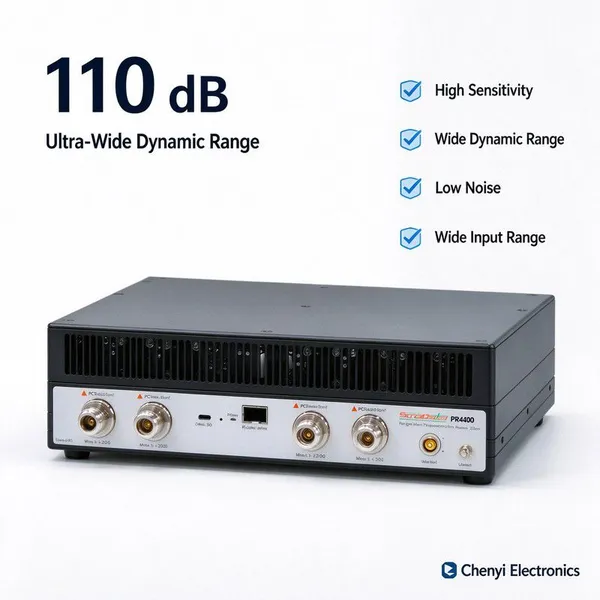 Read More

Contact Us
Recommended Products
-
 Signal Hound SM200C 100 KHz to 20 GHz Real-time Spectrum Analyzer With 10GbE Monitoring ReceiversNegotiableMOQ: 1 Unit
-
Signal Hound VSG200 Vector Signal Generator 100 KHz to 20 GHzNegotiableMOQ: 1 Unit
-
Signal Hound BB60C 9 KHz to 6 GHz Real-time Spectrum AnalyzerNegotiableMOQ: 1 Unit
-
Signal Hound BB60D 9 KHz to 6 GHz Real-time Spectrum AnalyzerNegotiableMOQ: 1 Unit
-
Signal Hound SP145 100 KHz to 14.5 GHz Real-time Spectrum Analyzer Monitoring ReceiversNegotiableMOQ: 1 Unit
-
Signal Hound VSG60A 50 MHz to 6 GHz GHz Vector Signal GeneratorNegotiableMOQ: 1 Unit
-
Signal Hound VSG25A 100 MHz to 2.5 GHz Vector Signal GeneratorNegotiableMOQ: 1 Unit
-
Signal Hound VNA400 40 MHz to 40 GHz 2-port Vector Network AnalyzerNegotiableMOQ: 1 Unit
-
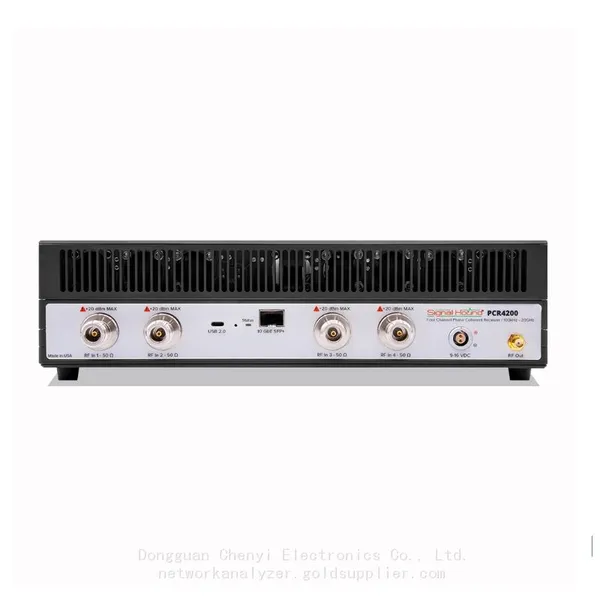
Signal Hound PCR4200 100 KHz to 20 GHz Four-Channel Phase Coherent ReceiverNegotiableMOQ: 1 Unit
-
Signal Hound TG124A 100 KHz to 12.4 GHz Tracking GeneratorNegotiableMOQ: 1 Unit
-
Signal Hound TG44A 10 Hz to 4.4 GHz t Tracking GeneratorNegotiableMOQ: 1 Unit
-
Signal Hound SA124B 100 KHz to 12.4 GHz Spectrum AnalyzerNegotiableMOQ: 1 Unit
-
Signal Hound SA44B 1 Hz to 4.4 GHz Spectrum AnalyzerNegotiableMOQ: 1 Unit
-
SM200B Real‑time Spectrum Analyzer,USB3.0 RTSA,100kHz-20GHz,calibrated I/Q Capture for 5G Test & Interference HuntingNegotiableMOQ: 1 Unit
-
Signal Hound SM435C 100 KHz to 43.5GHz Real-time Spectrum Analyzer With 10GbE Monitoring ReceiversNegotiableMOQ: 1 Unit
-
Signal Hound SM435B 100 KHz to 43.5GHz Real-time Spectrum Analyzer Monitoring ReceiversNegotiableMOQ: 1 Unit
-
Signal Hound PN400 Phase Noise and VCO Test System 100 KHz to 43.5 GHzNegotiableMOQ: 1 Unit
-
Keysight E4980A Precision LCR Meter 20 Hz to 2 MHzNegotiableMOQ: 1 Unit
-
Keysight E4980B and E4980BL Precision LCR Meter 20 Hz to 2 MHzNegotiableMOQ: 1 Unit
-
Keysight U1733C Handheld LCR Meter 100Hz 120Hz 1kHz 10kHz 100kHzNegotiableMOQ: 1 Unit